The Viksit Bharat Shiksha Adhisthan (VBSA) Bill stands as one of the most contentious pieces of legislation in contemporary India’s educational landscape. In this context, the VBSA Bill, which is proposed as a comprehensive framework to implement the National Education Policy (NEP) 2020, has therefore sparked intense debate among educators, constitutional scholars, and policymakers about the delicate balance between centralization and federalism in India’s higher education system.
What is the VBSA Bill? – An Introduction
The VBSA Bill, currently under review by a Joint Parliamentary Committee (JPC), proposes to establish a unified regulatory framework for higher education institutions across India. At its core, the bill aims to streamline the fragmented landscape of educational governance that currently exists under multiple regulatory bodies such as the University Grants Commission (UGC) and the All India Council for Technical Education (AICTE). In doing so, it seeks to reduce duplication and enhance efficiency.
Furthermore, the bill represents the government’s ambitious vision to create what it calls a “Developed India Education System” by consolidating various educational standards and creating a more cohesive regulatory ecosystem. However, this centralized approach has raised fundamental questions about whether such consolidation respects the constitutional provisions that govern education in India.
Constitutional Framework – The Constitutional Status of Education in India in VBSA Bill
Education: From State Subject to Concurrent Matter
Education in India has a unique constitutional journey. Initially, listed as a State subject in the Union List, however, it was moved to the Concurrent List through the 42nd Amendment Act of 1976. This shift was revolutionary. As a result, both the Union government and State governments can legislate on educational matters.
Article 66 of the Union List grants the Union government power over “Coordination and determination of standards in institutions for higher education or research and scientific and technical institutions.” Importantly,this provision limits the Centre’s role to standard-setting rather than absolute control.
Legal Governance Framework
Currently, higher education is governed through SILO model:
- University Grants Commission (UGC) Act, 1956: Regulates non-technical universities and provides funding
- All India Council for Technical Education (AICTE) Act, 1987: Oversees technical education
- Various Professional Councils: Medical Commission of India (NMC), Bar Council of India (BCI), and others regulate professional standards
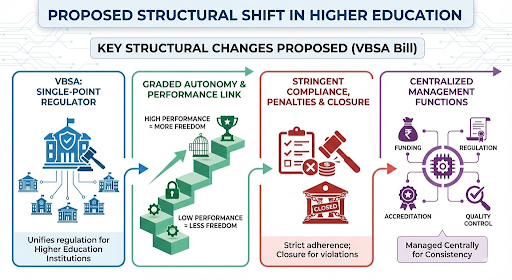
The Existing vs. Proposed Architecture – A Detailed Comparison
Current System: The “Silo Model” of Regulation
The present system is characterized by overlapping jurisdictions and fragmented governance. Consequently, multiple bodies regulate different aspects of higher education, thereby often creating confusion and contradictions:
- Over-regulation and Under-governance: While there are numerous bodies issuing guidelines, their coordination is poor
- Quality Variance: State-funded institutions often face different standards compared to Central institutions
- Funding Gaps: Clear disparity exists in resource allocation between Central and State institutions
- Political Interference: State governments sometimes appoint vice-chancellors without proper consultation with academic bodies
The HECI Framework: The Proposed Revolutionary Change
The VBSA Bill proposes to establish the Higher Education Commission of India (HECI) as a unified super-regulator with four main councils:
- NHERC (National Higher Education Regulatory Council): Single regulator for all institutions
- NAC (National Accreditation Council): Grading and accreditation of institutions
- HEGC (Higher Education Grants Council): Funding and financial matters
- GEC (General Education Council): Setting standards and learning outcomes
The Federalism Debate – Why the VBSA Bill is Controversial
Constitutional Overreach – Going Beyond Entry 66
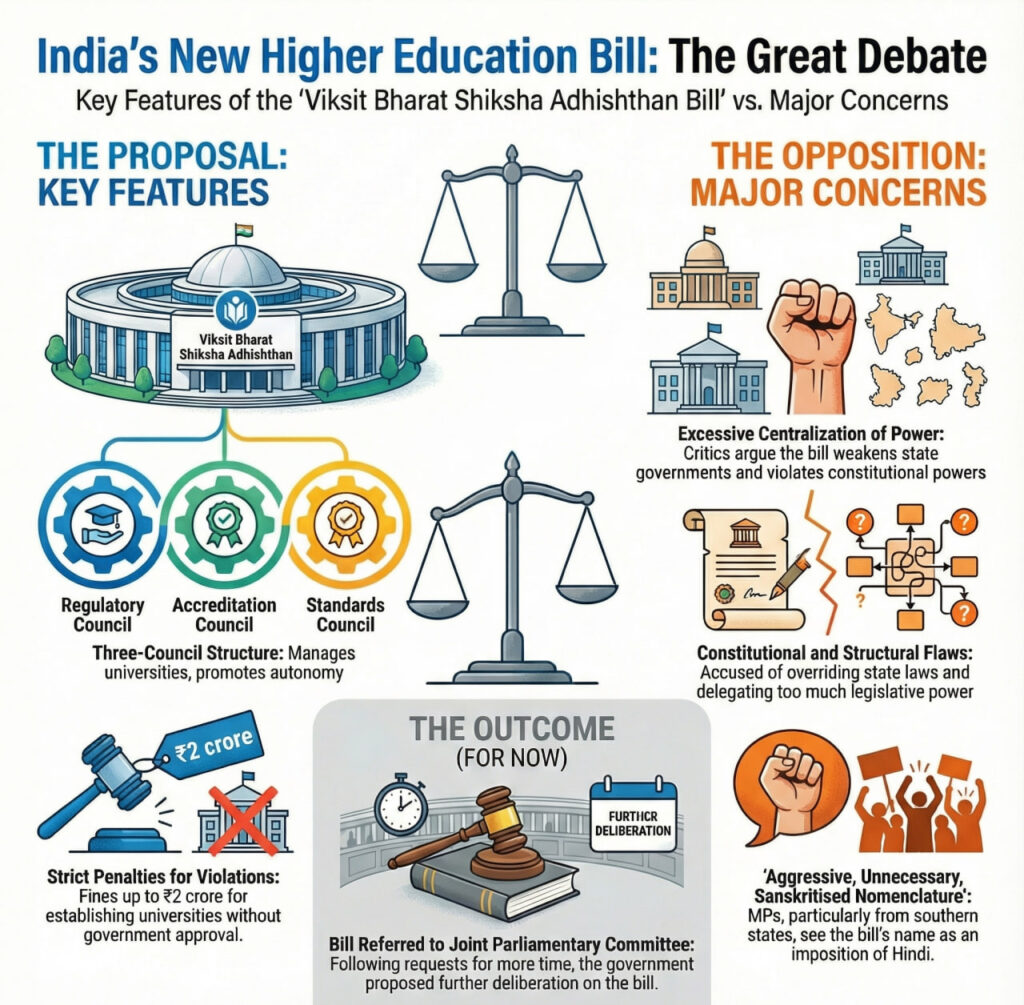
The most significant criticism of the VBSA Bill concerns its constitutional validity. While Entry 66 allows the Union to determine standards, the bill arguably goes far beyond this. In particular, it grants extensive administrative powers to Union-controlled bodies. As a result, concerns regarding constitutional overreach have intensified.
- Sole Discretionary Power: The bill grants Union-controlled councils virtually unlimited administrative functions
- Bypassing State Governments: State Higher Education Councils (SHECs) are relegated to advisory roles rather than being genuine partners
- Inspection Authority: Union bodies are empowered to conduct inspections without State participation
- Regulatory Monopoly: The Centre gains near-absolute power over institutional governance
If a Central government body can unilaterally determine not just standards, but also conduct inspections, issue directives, and control funding without State consultation, doesn’t this essentially convert a concurrent subject into a quasi-Union subject?
Additionally, one of the most troubling aspects of the VBSA Bill is its impact on institutional autonomy. For instance, prestigious institutions such as IITs and IIMs may face increased bureaucratic oversight. Consequently, this could undermine academic freedom and innovation.
Marginalization of States – The Federalism Crisis
Education is a Concurrent subject, meaning both the Union and States have equal legislative authority. However, the VBSA Bill effectively marginalizes State governments:
Issues with State Representation:
- State Higher Education Councils (SHECs) are barely mentioned in the framework
- No mechanism for States to have meaningful participation in standard-setting
- Decisions are framed as “top-down” rather than collaborative
- The fiscal burden on States increases (they must implement Union directives) without corresponding policy input
Example Scenario: If the HECI decides to change affiliation requirements for colleges, every State institution must comply, yet State governments had minimal say in this decision-making process.
Social Justice and Equity Concerns – The Missing Element
Equally important, a critical gap in the VBSA Bill is the absence of explicit provisions for affirmative action. Notably, the bill emphasizes merit and output-based metrics; however, it fails to adequately address historical inequalities and regional disparitie
A critical gap in the VBSA Bill is the absence of explicit provisions for affirmative action:
- No clear mandate for SC/ST/OBC reservations in private institutions
- The bill focuses on “merit” and “output-based metrics” without addressing historical inequalities
- Regional disparities in education access are not adequately addressed
- The linguistic diversity of Indian education (regional medium institutions) is underrepresented
The Problem in VBSA Bill with Output-Based Metrics
The VBSA Bill emphasizes output-based evaluation, measuring institution success primarily through metrics like patents and publications. This creates several problems:
- Disadvantage to Social Science and Humanities: Patents can not measure all valuable knowledge.
- Inequality Amplification: Institutions serving marginalized communities often focus on practical, local solutions, these don’t count as “outputs”
- Commercialization of Education: Pushes institutions toward treating education as a commercial enterprise rather than a public good
Bureaucratic Centralization – The Regulatory Council Model
From Consultative to Prescriptive Regulation
The current UGC operates through:
- Consultative processes with stakeholders
- Framework-based rather than prescription-based regulation
- Academic councils with representation from institutions
The proposed Regulatory Council (Viniyaman Parishad) would:
- Act as the primary enforcer of rules
- Operate with more prescriptive (detailed, directive) rather than facilitative regulations
- Reduce consultation with academic institutions
- Centralize decision-making authority
This shift represents a fundamental change in regulatory philosophy—moving from enabling institutions to govern themselves within broad guidelines, to detailed micromanagement from Delhi.
Government Initiatives and Alternative Models – A Way Forward
The Proposed Alternative Framework
Experts and States have proposed an alternative model based on shared responsibility:
Key Features of Alternative Model:
- 50/50 Weightage: Equal voice for SHECs and Union government in regulation and accreditation decisions
- Holistic Evaluation: Moving beyond output metrics to include social justice, regional development, and community impact
- Financial Integration: Establishing an HEGC that distributes funds equitably, bridging gaps between Central and State institutions
- Collaborative Standard-Setting: Standards determined through inter-state and inter-institutional dialogue
Way Forward – Strategic Recommendations for UPSC Preparation
Therefore, a balanced approach is required. On the one hand, standardization is essential for maintaining quality; on the other hand, excessive centralization may undermine federal principles. Hence, a collaborative model involving both the Union and States would be more sustainable.
Key Arguments for Examination
For Centralization Arguments:
- Need for uniformity in standards across India
- Elimination of bureaucratic red-tape through streamlining
- Better coordination in research and development
- Improved quality assurance mechanisms
Against Excessive Centralization Arguments:
- Violation of federal principles embedded in Constitution
- One-size-fits-all approach ignores regional diversity
- Reduction in institutional autonomy hurts academic excellence
- Social justice considerations sidelined for efficiency metrics
Critical Questions to Consider
- Can centralized governance deliver better outcomes in education without compromising diversity?
- How can India balance the need for standards with the constitutional autonomy of States?
- Does India truly need the VBSA Bill, or can we reform existing bodies?
- What role should private institutions play in a centralized system?
In conclusion, the VBSA Bill represents a critical turning point in India’s higher education governance, and its success will ultimately depend on how effectively it balances efficiency with federalism.
Important Related Previous Year Questions
Mains Exam (2023): “Explain the constitutional perspectives of cooperative federalism in India. Suggest measures to strengthen it.”
Prelims Exam (2018): “Regarding RUSA (Rashtriya Uchchatar Shiksha Abhiyan), which statements are correct?”
- This Bill is a Centrally Sponsored Scheme aimed at providing strategic funding to eligible state higher educational institutions.
- It aims to improve the overall quality of state institutions by ensuring conformity to prescribed norms and standards.
- It aims to create new institutions through the upgradation of existing autonomous colleges.
✔️ Answer: (d) 1, 2 and 3
Prelims Exam (2015): “Which of the following are included in the Concurrent List?
- Education
- Forests
- Trade unions
(a) 1 and 2 only
(b) 2 and 3 only
(c) 1, 2 and 3
(d) 1 only
✅ Answer: (c) 1, 2 and 3
To stay updated, follow UPSCVeda.in!