
For a long time, India faced a quiet but deeply worrying problem: the number of girls in the country was dropping fast. When the 2011 official headcount (Census) came out, it gave everyone a massive wake-up call. It revealed that for every 1,000 little boys under six years old, there were only 918 little girls. This happened because of old-fashioned mindsets where families heavily preferred boys, combined with the illegal use of medical scans to stop girls from being born.To fix this dangerous trend, the Government of India launched a massive program called Beti Bachao Beti Padhao (BBBP)—which translates to “Save the Girl Child, Educate the Girl Child”—on January 22, 2015, in Panipat, Haryana.
Over the years, this plan has grown from a small emergency rescue mission into a giant national movement. Today, it is completely changing how our society values girls.
The Structural Framework of BBBP
Instead of letting just one government office handle everything, BBBP brings three major ministries together to work as a team. This clever setup ensures that nobody works in isolation.
- The Ministry of Women and Child Development: They lead the big advertising campaigns, TV ads, and local events to change people’s minds.
- The Ministry of Health and Family Welfare: They check on hospitals, enforce protective laws, and make sure pregnant women get great medical care.
- The Ministry of Education: They focus on building schools, making sure girls enroll in classes, and helping them stay in school through high school.
At first, the government started this project in only 100 districts where the number of girls was dangerously low. However, because the plan worked so well, they quickly expanded it. Now, it covers all 640 districts across India, making sure every girl gets the same support.
Core Demographic Metrics & Formulas
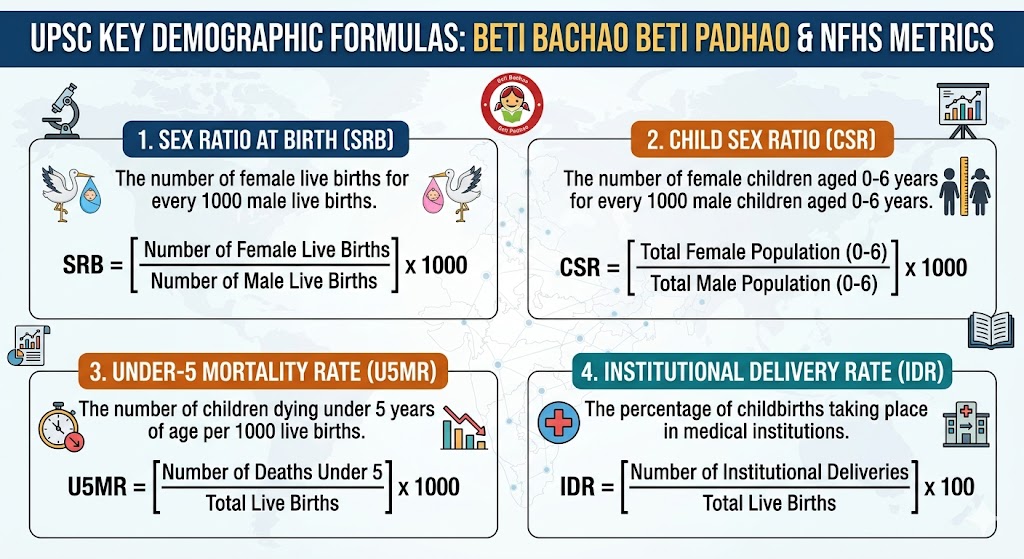
1. Child Sex Ratio (CSR)
UPSC Relevance: CSR evaluates long-term demographic trends and reflects the cumulative impact of anti-female discrimination over a specific six-year window.
2. Sex Ratio at Birth (SRB)
UPSC Relevance: Unlike CSR, SRB provides immediate, real-time feedback on the effectiveness of anti-sex selection laws and regional medical tracking.
3. Under-5 Mortality Rate (U5MR)
UPSC Relevance: A high female U5MR points directly to systemic neglect, poor post-natal nutrition, and limited healthcare access for young girls.
What Does the Latest Report Card Say? (NFHS-5 vs. NFHS-6)
To see if government plans actually work, India uses a huge national health report card called the National Family Health Survey (NFHS). The newest edition, NFHS-6, shows some amazing wins, but it also leaves us with a few big questions.
The Good News from the Latest Data
- More Hospital Births: Hospital births jumped to an all-time high of 90.6%, up from 88.6% a few years ago. When babies are born in a hospital, authorities can register them instantly, which stops illegal activities.
- Healthier Moms: More than 65% of pregnant mothers now get at least four health checkups before giving birth. Healthy moms naturally give birth to healthier babies.
- Girls Welcomed into the Digital Age: The number of women who have used the internet has nearly doubled, leaping from 33.3% to 64.3%! On top of that, almost 89% of women now run their own active bank accounts.
The Big Mystery in the Data
Even though the progress is exciting, there is a catch. In the latest NFHS-6 report card, the government decided to remove 30 important data points. Surprisingly, they dropped the Sex Ratio at Birth (SRB) and Child Mortality Rates from this specific survey.
The government explains that a different system will track these numbers instead. However, independent researchers note that removing these indicators makes it harder to double-check exactly how well the BBBP scheme is performing at a local, town-by-town level. For reference, the last time they checked (in NFHS-5), the birth ratio had climbed to a much healthier 929 girls for every 1,000 boys.
The Three Pillars Keeping the BBBP Movement Strong
The BBBP movement stands firmly on three main strategies:
- Strict Laws: The government uses a powerful law called the PCPNDT Act of 1994. This law makes it a severe crime for doctors or parents to use ultrasound machines to find out a baby’s gender before birth.
- Fun and Friendly Awareness: Instead of lecturing people, volunteers hold local birthday parties for baby girls, paint beautiful art on village walls, and create fun neighborhood campaigns to celebrate daughters.
- Smart Savings Accounts: Through a special program called Sukanya Samriddhi Yojana, parents can open high-interest savings accounts for their daughters. This ensures that families have plenty of money saved up for a girl’s college education, meaning daughters are never viewed as a financial burden.
The Path Forward
Despite these great victories, the fight is far from over. Old prejudices change slowly. Some people still find illegal, sneaky ways to use portable technology to bypass the law. Furthermore, some wealthy urban areas in places like Punjab and Haryana still need extra supervision because their girl-to-boy ratios remain too low.
Ultimately, to secure a bright future, we have to take the next big step. The conversation needs to shift from just helping girls survive to helping them become completely independent. True success will come when we expand “Beti Padhao” (Educate the Girl Child) into “Beti Kamayo” (Help the Girl Child Earn)—ensuring every girl can land a great job, lead a company, and stand as an equal leader in our society.
Prelims Specific Past Year Questions (PYQs)
Q1. With reference to the ‘Beti Bachao Beti Padhao’ scheme, consider the following statements:
- It is a joint initiative of the Ministry of Women and Child Development, Ministry of Health and Family Welfare, and Ministry of Education.
- It aims to achieve an equal sex ratio at birth across all Indian districts by completely replacing traditional diagnostic technology.
Which of the statements given above is/are correct?
A) 1 only
B) 2 only
C) Both 1 and 2
D) Neither 1 nor 2
Answer: A
Explanation: Statement 1 is perfectly correct; it is a tri-ministerial initiative. Statement 2 is incorrect because the scheme aims to regulate and prevent the misuse of diagnostic technology via the PCPNDT Act, not eliminate the medical technology itself.
Q2. The Pre-Conception and Pre-Natal Diagnostic Techniques (PCPNDT) Act was enacted by the Indian Parliament in which year? (State PCS Practice)
A) 1986
B) 1994
C) 2001
D) 2015
Answer: B
Explanation: The PCPNDT Act was passed in 1994 to combat the rampant menace of female foeticide and regulate prenatal diagnostic techniques.
For more such article, please refer to UPSCVeda.in