

For decades, India counted its GDP and measured its workforce. It celebrated its economy too. Yet, it somehow forgot the nation builder at home. This nation builder woke up before everyone else. She slept after everyone else too. On 11 June 2026, the Supreme Court of India finally spoke up. It said what many had felt for years. No law had dared to quantify it before. A homemaker’s labour has real, measurable economic value.
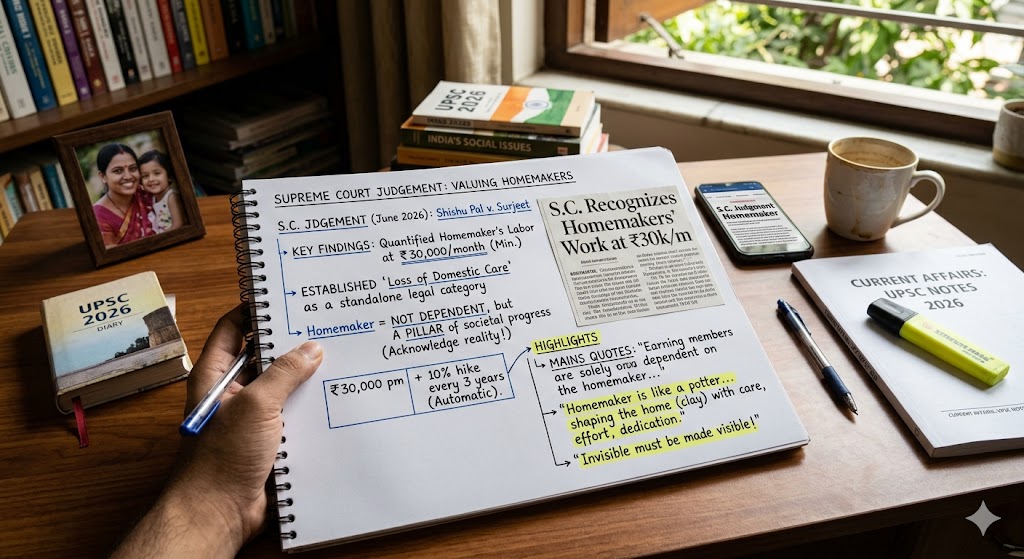
The Case That Made the Nation Builder Visible
The case, Shishu Pal @ Shish Ram & Ors. v. Surjeet & Ors., arose from a motor vehicle accident on 25 November 2001, in which a homemaker lost her life due to rash and negligent driving. Her family first approached the Motor Accident Claims Tribunal, which awarded only ₹2.42 lakh. Dissatisfied, they moved to the Punjab and Haryana High Court, which eventually enhanced the amount to ₹8.43 lakh. Still, the family felt the compensation fell far short of their actual loss. They then knocked on the doors of the Supreme Court — and the Supreme Court listened. The Indian Lawyer
How Courts Previously Failed
Until now, courts used “notional income” to calculate compensation for a deceased homemaker. Essentially, they just guessed what her work might be worth. However, the Supreme Court correctly pointed out a major flaw in this approach. Courts consistently undervalued homemakers because salary slips and GDP figures never captured their true contribution. Furthermore, existing heads of compensation, such as consortium, only addressed emotional loss. They completely ignored the very real economic gap. This gap opens up when a household loses its primary manager, caregiver, and organiser.
To address this gap, the Court introduced a brand new head of compensation called “Loss of Domestic Care.” It directed that where the death of a homemaker causes loss of household management, maternal support, and spousal or parental care, a minimum composite amount of ₹30,000 per month must be added while calculating compensation. Moreover, the Court directed that this figure should increase by 10% every three years. As a result of applying these principles, the claimants in this case ultimately received a total compensation of ₹62,77,900. theindianlawyer
The Language That Defined the Nation Builder
Beyond numbers, the moral force of the Court’s language truly stood out. A bench of Justices Sanjay Karol and N. Kotiswar Singh observed that homemakers contribute far beyond household chores. They play a crucial role in building families, communities, and ultimately the nation. The Court directly remarked: “Housewives contribute to the household. They are nation builders. They build the nation.” Additionally, Justice Karol pointed out a profound irony. Society calls a homemaker a “dependant.” Yet, in reality, the entire household depends on her.
Why Every UPSC Aspirant Must Know this Judgment
This judgment connects to several core themes in the UPSC syllabus. First, it advances gender justice and the recognition of unpaid care economy — a concept that India’s National Family Health Survey data consistently highlights but policy rarely addresses. Second, it links directly to Article 21 (Right to Life with dignity) and the broader constitutional guarantee of equality. Third, the Motor Vehicles Act and the role of tribunals in fair compensation fall under governance and social justice. Finally, this ruling builds upon the earlier 2021 Supreme Court judgment in Kirti v. Oriental Insurance Co., which had first raised the issue of the gendered nature of housework in compensation calculations.
A Verdict That Builds the Nation Builder Up
Ultimately, this judgment does not merely fix a number. Instead, it corrects a long-standing injustice. As Justice Karol’s bench observed, it is ironic — and indeed unjust — that the person who holds a home together, raises the next generation, and enables every other family member to pursue their ambitions outside the home has, for so long, been treated by the law as economically invisible.
Quote for Mains answers: “The homemaker builds the nation. To describe her as a dependant is an irony — for the entire household depends on her.” — Supreme Court of India, Shishu Pal @ Shish Ram v. Surjeet, June 11, 2026.
Quote for Mains answers: “Unpaid domestic labour cannot be dismissed as economically insignificant merely because it does not generate a formal salary.” — Supreme Court of India, 2026.
The nation builder has always been there. Now, finally, the law sees her too.
Q. With reference to the Indian economy, consider the following statements regarding the Female Labor Force Participation Rate (LFPR) and Time Use Surveys:
- The Time Use Survey in India is conducted periodically by the NITI Aayog to measure unpaid volunteer work.
- Unpaid domestic and caregiving work performed by women is currently included in the official calculation of India’s Gross Domestic Product (GDP).
Which of the statements given above is/are correct? (a) 1 only
(b) 2 only
(c) Both 1 and 2
(d) Neither 1 nor 2
Correct Answer: (d) Neither 1 nor 2 Explanation: Statement 1 is incorrect because the Time Use Survey is conducted by the National Sample Survey Office (NSSO) under the Ministry of Statistics and Programme Implementation (MoSPI), not NITI Aayog. Statement 2 is incorrect because conventional GDP calculations omit unpaid domestic services and caregiving work performed by homemakers within households due to the difficulty of monetizing non-market transactions.