

The Supreme Court is examining the constitutional validity of the Chief Election Commissioner Act 2023. In March 2023, the Supreme Court ruled in the Anoop Baranwal case that a committee comprising the Prime Minister, the Leader of the Opposition, and the Chief Justice of India would advise the President on appointing the CEC and ECs until Parliament enacted a law.
Article 324 of the Indian Constitution creates the Election Commission of India (ECI) as an independent constitutional body. Article 324 also envisages Parliament making a law concerning the appointment of Election Commissioners. This relates to the Chief Election Commissioner Act 2023.
What did the Supreme Court say in 2023?
Before Parliament enacted a law, there was no detailed statutory framework governing the appointment process. As a result, Anoop Baranwal v. Union of India (2023) featured a five-judge Constitution Bench addressing the gap. Union of India (2023) thus highlighted the need for reforms under the Chief Election Commissioner Act 2023.
The Court directed that, until Parliament made a law, a three-member committee should recommend the appointments. Additionally, it would comprise three members.
- Prime Minister
- Leader of Opposition in the Lok Sabha
- Chief Justice of India
Additionally, the arrangement aimed to prevent exclusive executive control over appointments while Parliament considered the legislation.
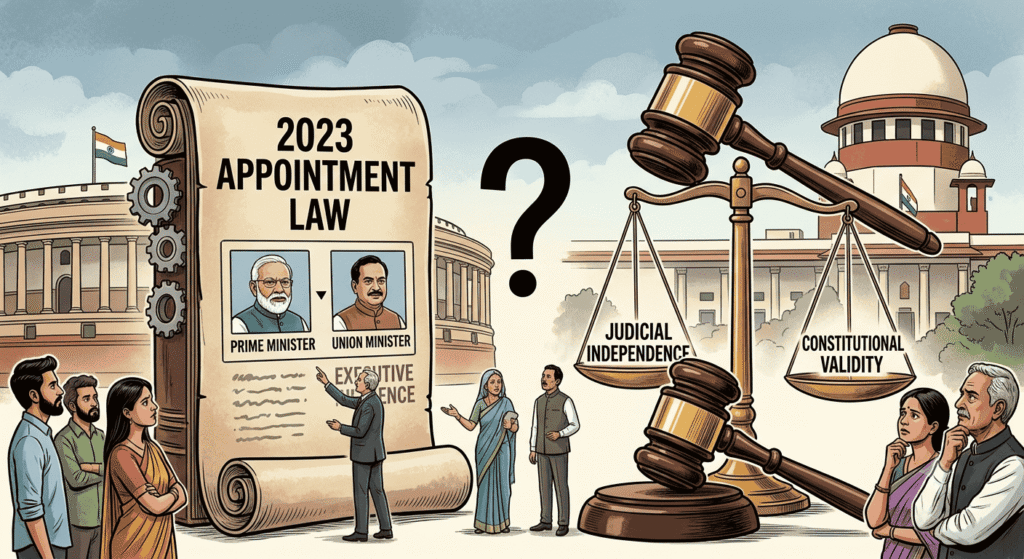
What changed under the 2023 Act? Chief Election Commissioner Act 2023
Parliament enacted the Chief Election Commissioner Act 2023 later that year. Additionally, it created a statutory appointment mechanism. It included a Search Committee and a Selection Committee.
The Selection Committee comprises:
| Member | 2023 Act |
|---|---|
| Prime Minister | Member |
| Union Cabinet Minister nominated by PM | Member |
| Leader of Opposition in Lok Sabha | Member |
Furthermore, under the Chief Election Commissioner Act 2023, the Chief Justice of India was replaced by a Union Cabinet Minister. The minister was nominated by the Prime Minister.
This has become the central point of the constitutional challenge under the Chief Election Commissioner Act 2023. Moreover, the petitioners say two executive members on the three-member committee could give the government influence over the selection. They contend that the independence of the Election Commission is essential for free and fair elections.
The Union government, however, argues that the Anoop Baranwal arrangement was only an interim mechanism. Moreover, once Parliament exercised its power under Article 324, it was entitled to create its own statutory framework.
However, why is the Supreme Court examining it again?
The Supreme Court has not yet declared the Chief Election Commissioner Act 2023 unconstitutional. Moreover, on 23 September 2026, Justices Dipankar Datta and Satish Chandra Sharma differed. They disagreed on whether the existing bench should decide the case or refer it to a larger Constitution Bench.
Justice Datta considered the principles laid down in Anoop Baranwal sufficiently established to examine the legislation. However, he also raised concerns about the perception of independence when the executive has two members on the selection committee.
Justice Sharma considered the constitutional validity of the Chief Election Commissioner Act 2023. Moreover, it involved a substantial question requiring consideration by a Constitution Bench under Article 145(3).
Why does this matter?
The case goes beyond the question of whether the CJI should sit on the selection committee. Additionally, it raises a broader constitutional issue. It asks how Parliament’s power to regulate appointments under Article 324 should balance with an independent Election Commission. For instance, the Chief Election Commissioner Act 2023 provides a framework for such appointments.
For UPSC, the case connects Article 324, constitutional bodies, and free and fair elections.
Moreover, it ties in judicial review, separation of powers, institutional independence, the Chief Election Commissioner Act 2023, and structure doctrine. As of September 2026, the 2023 Act remains in force. Its constitutional validity is yet to be finally decided by the Supreme Court. Moreover, the upcoming Constitution Bench could become an important development in India’s electoral reforms and constitutional institutions.
Prelims Previous Year Question (PYQ)
Q: Which of the following are the functions of the Election Commission of India? (UPSC Prelims 2020)
- Supervising the preparation of electoral rolls.
- Conducting elections to the Parliament and State Legislatures.
- Setting the election dates.
Choose the correct answer using the code given below:
a) 1 and 2 only
b) 2 and 3 only
c) 1 and 3 only
d) 1, 2 and 3
(Correct answer: d)
Mains Question
Discuss the importance of the Election Commission’s independence in ensuring free and fair elections in India. Additionally, examine concerns over its autonomy and suggest measures to strengthen it, such as the Chief Election Commissioner Act 2023.
Conclusion
The Election Commission’s role cannot be understated in India’s democracy. Moreover, protecting its independence remains a national priority under the Chief Election Commissioner Act 2023. The investigation by Indian Express serves as a reminder of the constant vigilance democracy needs.