
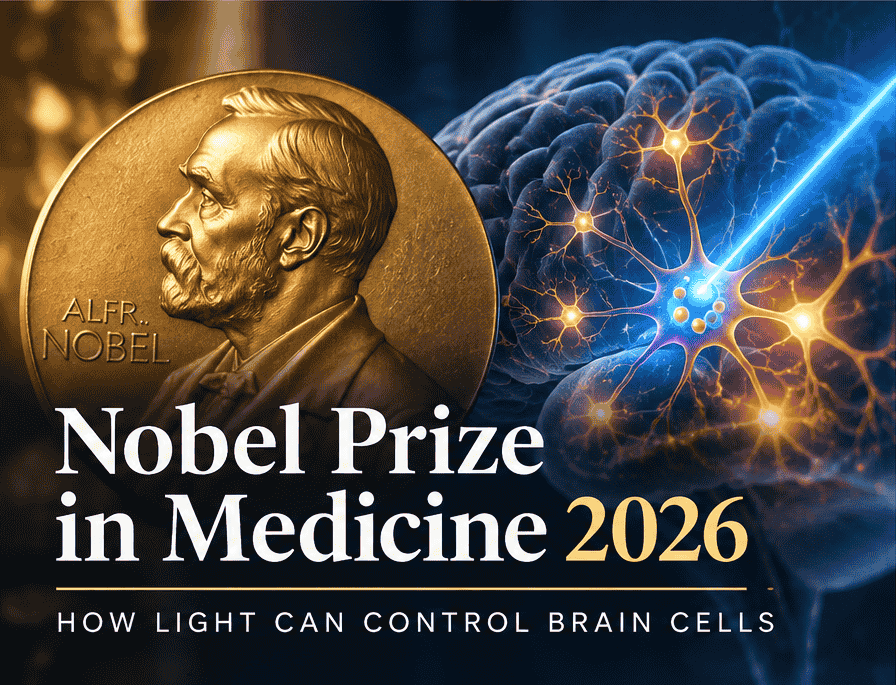
The Nobel Prize in Medicine 2026 has recognised a discovery that could change how scientists study the human brain. On 5 October 2026, the Nobel Assembly at Karolinska Institutet announced three scientists as the winners.
Karl Deisseroth, Peter Hegemann and Georg Nagel received the award for their discoveries concerning light-gated ion channels and optogenetics.
Their research allows scientists to control specific nerve cells using light. As a result, researchers can better understand how the brain controls memory, emotions and behaviour.
Who Won the Nobel Prize in Medicine 2026?
The Nobel Prize was jointly awarded to three scientists:
- Karl Deisseroth: Stanford University and Howard Hughes Medical Institute, USA.
- Peter Hegemann: Humboldt University of Berlin, Germany.
- Georg Nagel: University of Würzburg, Germany.
Together, they will share a prize of 12 million Swedish kronor.
Their discovery has opened new possibilities in neuroscience. Moreover, it could support future treatments for several neurological disorders.
What Is Optogenetics?
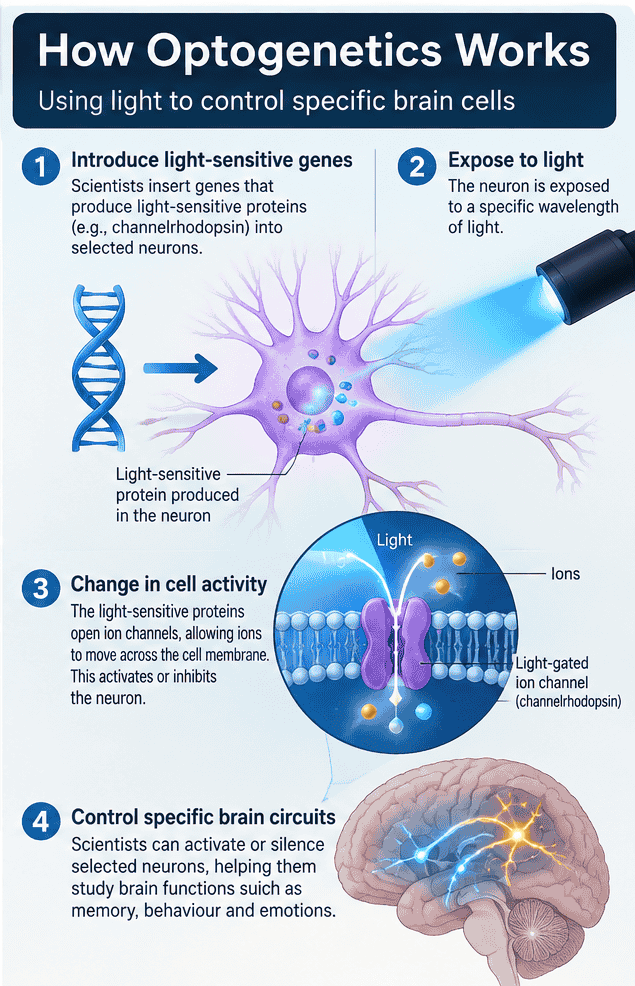
Optogenetics is a scientific technique that combines genetics and light to control the activity of specific cells.
Normally, nerve cells communicate through electrical and chemical signals. However, scientists previously struggled to control individual nerve cells with precision.
Optogenetics changed this situation.
First, researchers introduce genes that produce light-sensitive proteins into selected nerve cells. Next, they expose these cells to specific wavelengths of light.
Consequently, the proteins respond to light and change the electrical activity of the cells.
Thus, scientists can activate or silence particular nerve cells. This helps them understand the role of different brain circuits.
How Did Scientists Make this Nobel Prize Discovery?
Interestingly, the discovery began with a simple green alga called Chlamydomonas.
Peter Hegemann studied how this alga responds to light. Later, he worked with Georg Nagel to investigate its light-sensitive proteins.
Their research helped identify channelrhodopsin, a protein that acts as a light-controlled ion channel.
In 2003, Hegemann and Nagel demonstrated how these proteins could generate electrical signals in other cells.
Subsequently, in 2005, Karl Deisseroth and his team successfully used this approach to control nerve cells in laboratory experiments.
This breakthrough laid the foundation for modern optogenetics.
Why Is This Discovery Important?
The human brain contains billions of interconnected nerve cells. Therefore, understanding the function of individual cells remains challenging.
However, optogenetics allows researchers to study specific brain circuits more accurately.
For example, scientists can investigate how the brain forms memories, regulates emotions and controls movement.
Furthermore, researchers use this technique to study several conditions, including:
- Alzheimer’s disease
- Parkinson’s disease
- Epilepsy
- Schizophrenia
- Addiction
Additionally, scientists are exploring its potential to restore vision in people with certain retinal disorders.
Nevertheless, most applications for treating brain disorders remain experimental. Further research and clinical trials are necessary.
Conclusion
The Nobel Prize in Medicine 2026 highlights how a simple observation in algae transformed neuroscience.
Through optogenetics, scientists can now study brain cells with remarkable precision.
Although several medical applications remain under development, the discovery offers hope for future treatments.
Ultimately, it shows how curiosity-driven research can create solutions to complex human problems.
Quick UPSC Revision
| Topic | Key Fact |
|---|---|
| Nobel Prize | Physiology or Medicine 2026 |
| Winners | Karl Deisseroth, Peter Hegemann and Georg Nagel |
| Discovery | Light-gated ion channels and optogenetics |
| Main Technique | Controlling nerve cells using light |
| Important Protein | Channelrhodopsin |
| Source Organism | Chlamydomonas (green alga) |
| UPSC Relevance | GS Paper III: Science and Technology |
UPSC Prelims Practice Question Related to Nobel Prize Win
Q. With reference to Optogenetics, which was recognised by the Nobel Prize in Physiology or Medicine 2026, consider the following statements:
- Optogenetics combines genetic techniques and light to control the activity of specific cells.
- Channelrhodopsins are light-sensitive proteins that can regulate the movement of ions across cell membranes.
- Optogenetics is primarily used to permanently modify the DNA of nerve cells to treat neurological disorders.
Which of the statements given above are correct?
(a) 1 and 2 only (b) 2 and 3 only (c) 1 and 3 only (d) 1, 2 and 3
Correct Answer: (a) 1 and 2 only
Explanation:
- Statement 1 is correct: Optogenetics uses genetic methods and light to control specific cells, particularly neurons.
- Statement 2 is correct: Channelrhodopsins are light-gated ion channels that allow ions to cross cell membranes in response to light.
- Statement 3 is incorrect: Optogenetics primarily aims to control cellular activity rather than permanently modify DNA to cure neurological diseases. Most therapeutic applications remain experimental.
UPSC Relevance: GS Paper III – Science and Technology | Biotechnology | Neuroscience