
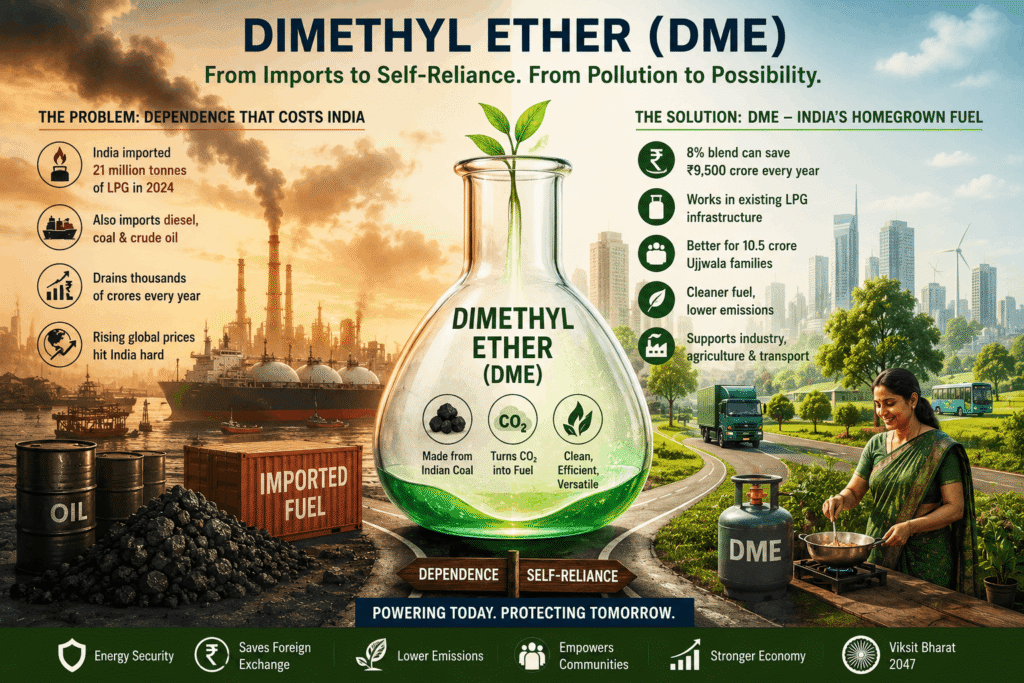
Every month, a gas cylinder arrives at millions of Indian homes. Families use it to cook food. It runs on LPG — a fuel India mostly buys from other countries. In fact, India imported nearly 21 million tonnes of LPG in 2024 alone. On top of that, India also imports diesel, coal, and crude oil. Together, these imports drain a huge amount of India’s money every single year. Worse still, whenever global prices rise, India’s economy takes a direct hit. This is where dimethyl ether (DME) could offer India a promising alternative, helping reduce its dependence on imported LPG and strengthen energy security.
So the big question is — can India find a better way?
The answer might lie in a colourless gas that most people have never heard of. It is called Dimethyl Ether. Scientists also call it DME.
First, What Exactly is Dimethyl Ether ?
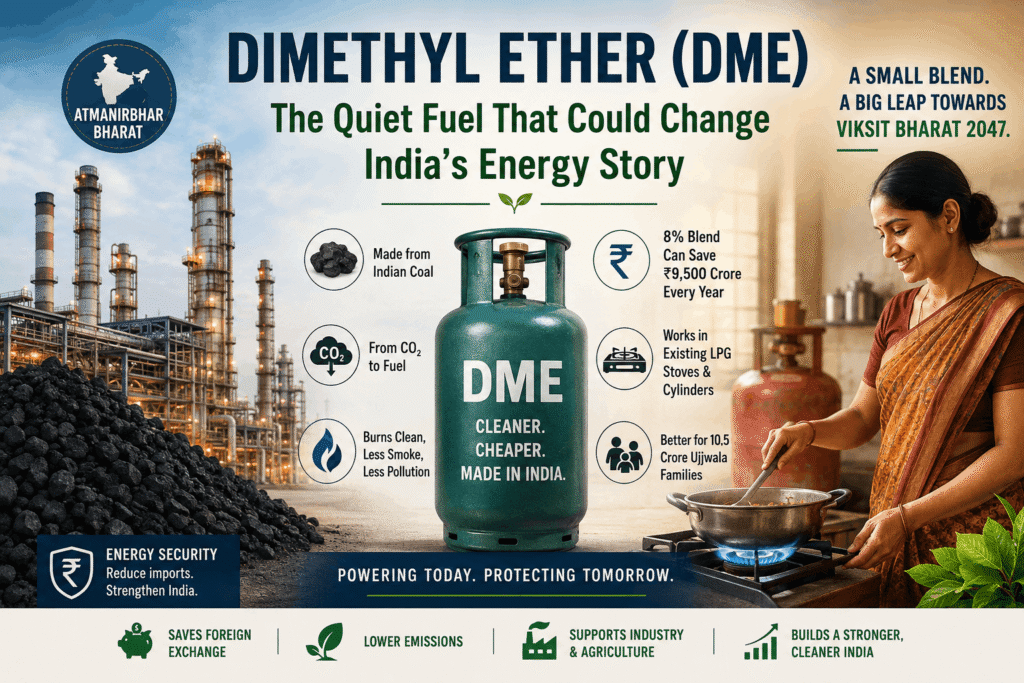
DME is a synthetic fuel. In simple terms, it is a fuel made in a lab or factory, not pumped out of the ground directly. Under normal conditions, it is a colourless and odourless gas. However, it burns very cleanly. For instance, it produces far less soot, smoke, and harmful gases compared to petrol or diesel. At the same time, it gives roughly the same heat as LPG. So you cook just as fast, but with far less pollution.
But here is the most important part. DME can be made from Indian coal. India has enormous coal reserves. Therefore, India does not need to import DME. The raw material is already available right here at home. Additionally, Dimethyl Ether can also be made from CO2 — the same gas that factories release as pollution. In other words, India can turn its own waste gas into usable fuel.
What Did India’s Scientists Do?
In March 2026, scientists at CSIR-National Chemical Laboratory in Pune made a major announcement. They developed a technology to produce DME entirely within India. Moreover, this technology is patent-protected. That means no other country owns it. India does.
This is significant for one simple reason. India has spent decades depending on foreign countries for critical energy technologies. Therefore, having a home-grown method for DME production is a big step forward for Atmanirbhar Bharat.
Meanwhile, researchers at BITS Pilani, Hyderabad, took a different approach. Their project converts CO2 and hydrogen into DME using special catalysts in a high-pressure reactor. As a result, DME can potentially be made from captured industrial emissions. In other words, India can convert a pollution problem directly into an energy solution.
Now, Let Us Talk Numbers
Science alone does not change policy. Numbers do. And the numbers around DME are genuinely striking.
India imported nearly 21 million tonnes of LPG in 2024. Scientists estimate that replacing just 8 per cent of that LPG with DME could save around ₹9,500 crore in foreign exchange every single year. To put it simply, that is nearly ten thousand crore rupees staying inside India instead of going abroad.
Furthermore, here is the best part. Blending 8 per cent DME with LPG does not require any changes to existing cylinders, stoves, pipes, or regulators. So families do not need to buy anything new. The existing system simply accepts the blend as it is.
The Bureau of Indian Standards has already recognised this opportunity. It has issued standard IS 18698:2024, which officially allows blending up to 20 per cent DME with LPG for household, commercial, and industrial use. In short, the rules are already in place. What remains now is large-scale production.
How Does Dimethyl Ether Connect to Viksit Bharat 2047?
India wants to become a fully developed economy by 2047. However, this goal has a serious obstacle. India currently imports about 90 per cent of its oil and 80 per cent of its industrial coal. Every time global oil prices go up, India’s foreign exchange reserves go down. As a result, inflation rises and ordinary people feel the pinch directly.
DME can help break this cycle. Here is how.
First, it reduces the import bill. Every tonne of DME produced domestically means one less tonne of LPG imported. Second, its raw material — coal — is already available inside India. So the entire production chain stays within the country. Third, it burns cleaner than LPG or diesel. Therefore, India gets energy security and lower pollution at the same time. Fourth, since it works with existing infrastructure at low blending ratios, the cost of switching is very small compared to other alternatives like hydrogen.
For the 10.5 crore families covered under the Pradhan Mantri Ujjwala Yojana, this matters directly. Their cooking gas becomes cheaper, cleaner, and less dependent on decisions made in distant countries.
Is DME Only For Cooking?
Not at all. In fact, DME has uses far beyond the kitchen.
DME can also power specially designed diesel engines. Consequently, it has potential in trucks, tractors, agricultural engines, and industrial machines. These are sectors where switching to electricity is extremely difficult and expensive. Therefore, DME acts as a practical bridge — reducing emissions right now, while India continues building solar and wind capacity in the background.
Additionally, DME is not competing with other clean fuels like green hydrogen. Instead, it complements them. Both can play different roles in India’s larger energy plan. Together, they make the energy transition more practical and more affordable.
What Still Needs to Be Done?
To be honest, DME is not fully ready for every Indian home just yet. The technology exists. The standards exist. The science is solid. However, large-scale industrial production has not happened yet.
Currently, CSIR-NCL is working on scaling up the technology to build a full industrial demonstration plant. Furthermore, it is also looking for partnerships with oil PSUs like IOCL, BPCL, and HPCL. These companies control the pipelines, cylinders, and distribution networks that DME would need to reach millions of homes and factories.
Besides manufacturing, policy support is equally important. Clear production incentives, government contracts, and inclusion of DME in national energy planning will all be necessary to speed things up.
Why This Fuel Fits India’s Moment Perfectly
India is at a rare point in history right now. It has massive and growing energy needs and it has the domestic resources to produce alternatives. It has a government committed to self-reliance. And now, for the first time, it also has indigenous technology to actually make DME at scale.
Of course, DME alone will not replace all of India’s imported oil. However, it does not need to. Even small, consistent reductions in LPG imports — starting at 8 per cent and growing toward 20 per cent — add up to enormous savings over two decades.
And two decades is exactly the time India has until 2047.
Therefore, this quiet, colourless gas deserves far more attention than it currently gets. The kitchen may seem like an unlikely place to start the journey to a developed India. But energy security, almost always, begins right at home — literally.
Prelims-Style Practice Question
Q. Consider the following statements about Dimethyl Ether (DME):
- DME has been developed indigenously by CSIR-National Chemical Laboratory (CSIR-NCL), Pune.
- As per BIS standard IS 18698:2024, DME can be blended with LPG up to a maximum of 20 per cent.
- Blending even 8 per cent DME with LPG requires modification of existing cylinders and stoves.
- DME can be produced from Indian coal as well as from captured CO2.
How many of the above statements are correct?
(a) Only two
(b) Only three
(c) All four
(d) Only one
Answer: (b) Only three — Statements 1, 2, and 4 are correct. Statement 3 is incorrect because blending up to 8 per cent DME requires no modification to existing household infrastructure, which is precisely what makes it practically viable at scale.