
This article explores the Sacrifice Ratio, a key concept in economics that measures the “pain” or cost of reducing inflation. It specifically quantifies how much economic growth (GDP) a country must surrender to lower its inflation rate by 1%.
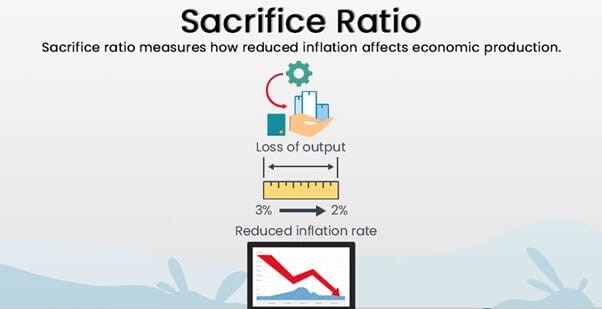
1. The Core Concept: No Free Lunch
In economics, most things come with a trade-off. When a central bank (like the RBI or the Fed) decides that inflation is too high, it raises interest rates. While this cools down prices, it also slows down the economy.
- The Formula: If an economy loses 4% of its GDP to bring inflation down by 2%, the Sacrifice Ratio is 2.0.
- The Logic: Higher rates lead to less spending, lower production, and higher unemployment. The Sacrifice Ratio tells us exactly how much of a “recession” we are buying to get stable prices.
2. Key Links: How It Works
To understand the ratio, we look at three fundamental economic rules:
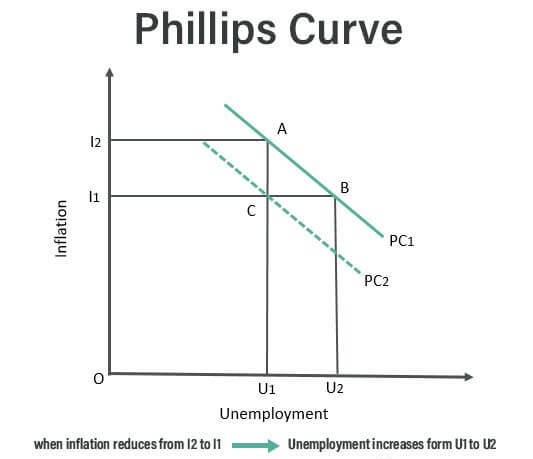
- The Phillips Curve: This is the basic idea that inflation and unemployment move in opposite directions. To pull inflation down, unemployment usually has to go up.
- Okun’s Law: This links jobs to growth. It suggests that for every 1% increase in unemployment, a country loses about 2% of its potential GDP.
- Expectations: Crucially, if people believe the central bank will succeed, they don’t demand higher wages or raise prices as aggressively. This “credibility” makes the sacrifice much smaller.
3. Real-World Evidence: US, UK, and India (2021–2024)
While history shows high costs (like the 1980s Volcker era), the post-pandemic period has been surprisingly “painless.” This is often called “Immaculate Disinflation.”
| Region | Sacrifice Ratio | Why? |
| USA | ~0 to 0.5 | Inflation fell sharply, but the economy kept growing and jobs stayed plentiful. |
| India | ~0.4 to 0.7 | The RBI raised rates, but strong government spending and local demand kept growth at 6-7%. |
| UK | ~0.8 to 1.2 | Costs were higher here due to massive energy shocks and labor shortages following Brexit and the pandemic. |
Transitioning from these numbers, it is clear that the “cost” was low this time because inflation was mostly caused by supply chain breaks that fixed themselves, rather than just excessive demand.
4. Why Does the Sacrifice Ratio Change?
The sacrifice isn’t a fixed number; it changes based on several factors:
- Trust: Credible central banks have lower ratios.
- Flexibility: Countries with flexible job markets (like the US) usually recover faster than those with rigid laws.
- Openness: Economies that trade more globally often find it easier to cool down prices without crushing local industry.
In short, the Sacrifice Ratio is the “price tag” on price stability. While the 1980s taught us that fighting inflation often requires a massive sacrifice of jobs and growth, the early 2020s offered a different lesson. We saw that if inflation is caused by temporary supply shocks and the public trusts the central bank, we can sometimes lower inflation without a deep recession.
However, the landscape has shifted dramatically in 2026.
We are currently witnessing a spike in the sacrifice ratio due to the escalating conflict between Iran and US-backed Israel. The primary driver of this economic pain is the blockade of the Strait of Hormuz, a critical chokepoint for global oil and trade. This disruption has sent shockwaves through international markets, forcing central banks to tighten policy just as supply chains crumble.
The Impact on India
In India, the situation has become particularly visible. As energy costs soar and industrial production slows, we are seeing a tragic “reverse migration.” Similar to the pandemic era, mass groups of laborers are migrating from major cities back to their homelands. This movement signals a cooling economy where urban jobs are disappearing, leaving workers with no choice but to return to rural safety nets.
Consequently, the sacrifice ratio in 2026 is climbing. India is being forced to trade away its hard-won growth momentum to combat “imported inflation” caused by a war halfway across the globe.
Key Takeaway: While the “Immaculate Disinflation” of the early 2020s was relatively painless, the geopolitical crises of 2026 prove that when global supply lines are physically severed by war, the “sacrifice” required to stabilize an economy becomes much higher once again.