
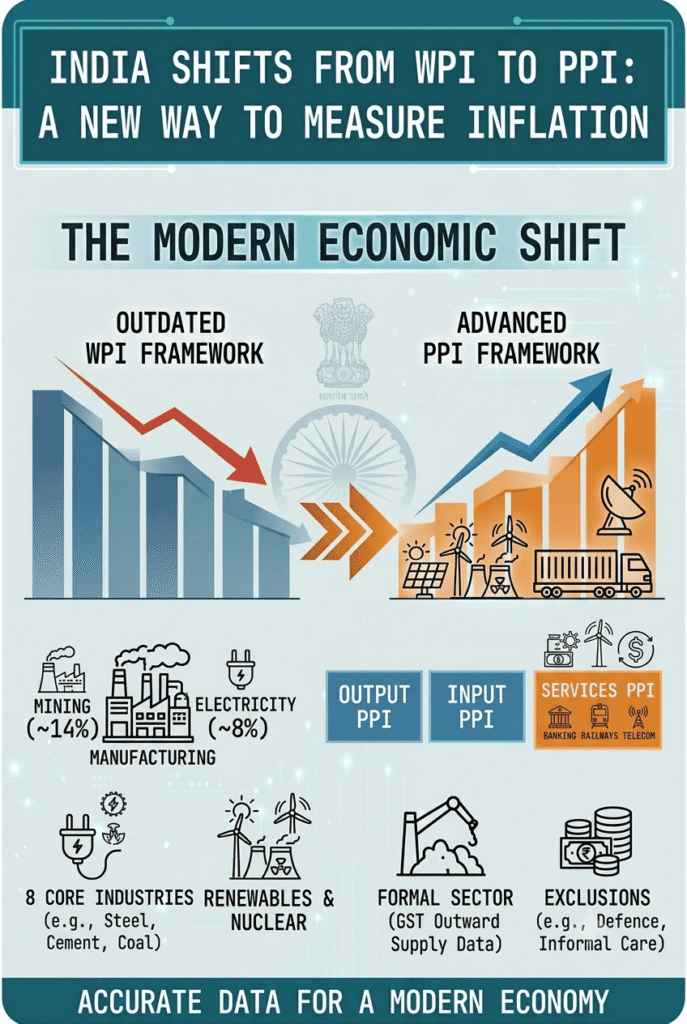
For decades, if you wanted to know how prices were moving at the wholesale level in India, you turned to the WPI — the Wholesale Price Index. It’s been the standard tool for tracking producer-level inflation since forever, or at least it feels that way. But that era is now ending. The government has decided to retire WPI and bring in a new index instead: the Producer Price Index, or PPI.
This isn’t a small tweak. It’s a genuine overhaul of how India measures inflation.
So why fix something that wasn’t obviously broken?
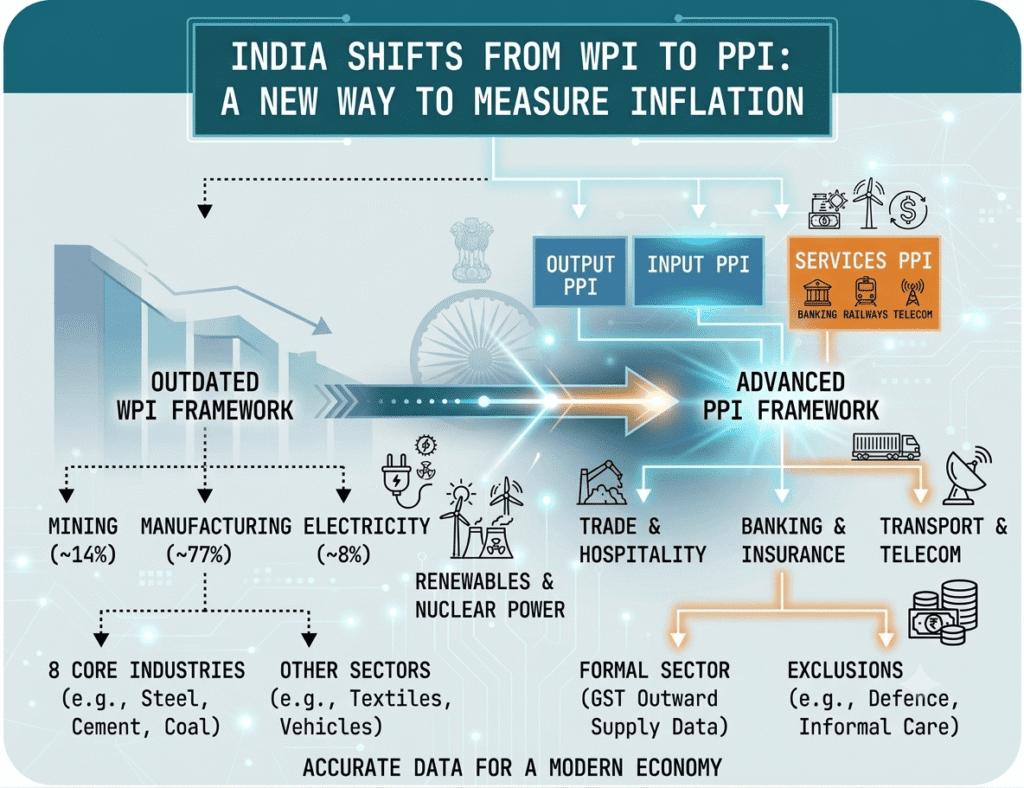
Well, turns out WPI had a pretty big blind spot. It excludes services, which constitute a major portion of India’s GDP. Think about that for a second — the government designed an index to capture producer-side inflation, yet it excludes banking, insurance, telecom, and a whole lot more. That’s a glaring gap in an economy where services contribute so much.
PPI fixes this. It measures prices received by domestic producers for their output—goods and services—covering both input and output perspectives. So instead of getting half the picture, you get the whole thing.
And honestly, India isn’t reinventing the wheel here. Most advanced economies already use PPI instead of WPI. Economists believe the PPI aligns better with modern economic structures and international standards, reflecting the UN System of National Accounts and IMF recommendations. So in a way, India is just catching up.
What’s actually changing
Two things are happening at once, which can get a little confusing if you’re not paying close attention.
First, the government updated the WPI’s base year, revising the Wholesale Price Index baseline from 2011–12 to 2022–23. It makes perfect sense—a baseline from 2011 was getting pretty stale.
Second, alongside this revised WPI, the government is rolling out an entirely new PPI framework. It’s not just one index either. The government is releasing a new price index series with a 2022-23 base year. This framework introduces the Output Producer Price Index (OPPI), the Trial Input Producer Price Index (IPPI), and a Service Producer Price Index that covers seven key services: Banking, Securities Transaction, Insurance, Management of Pension Funds, Railways, Air Passenger transport, and Telecom.
The basket of items got bigger too. The total number of items increased from 697 to 957. The government made some interesting additions, pulling renewable sources like solar and wind power under the Electricity umbrella and introducing nuclear power to the basket. Analysts will also appreciate the reshuffling of crude petroleum and natural gas; shifting them from Primary Articles to Fuel and Power aligns them perfectly with coal, electricity, and petroleum products.
Did the Government Kill WPI For Good?
Not quite—and people often get this wrong. The government won’t scrap WPI overnight. Why? Because thousands of businesses still tie their contracts, government tenders, and price-escalation clauses directly to it. Pulling the plug suddenly would trigger economic chaos.
So the government’s playing it safe. The government will continue to release the WPI for five years after launching the revised series, running it alongside the PPI before finally discontinuing it. That gives businesses and institutions enough breathing room to make the switch without scrambling.
When did this actually kick off?
This isn’t some far-off plan still on paper. It already happened. On 15 June 2026, the government released the revised WPI series with a 2022-23 base year, officially replacing the old 2011-12 series.
The first batch of PPI data came out around the same time too.
Why should anyone care?
Better data simply drives better decisions. Placing an Output PPI and an Input PPI side by side sharpens our view of the economic landscape. As the government notes, tracking both indices clarifies how input costs affect final output prices, tracing exactly how input inflation passes through to the finished product.
The new system also quietly solves a major technical challenge: it refines GDP calculations. Having both price indices enables ‘double deflation’ when estimating Real GDP. Perhaps most importantly, PPI outshines WPI by accurately measuring price changes from the producer’s perspective, making it an invaluable tool for national accounts.
Bottom line
India is moving on from an index that’s served its purpose but has clearly outgrown its usefulness. PPI is the upgrade — broader, more accurate, and more in line with how the rest of the world measures inflation. WPI isn’t disappearing tomorrow, though. It’ll stick around for five more years as a safety net while everyone adjusts. And in the meantime, its base year has already jumped from 2011-12 to 2022-23, giving us fresher, more relevant data right away.
It’s not the flashiest reform, but if you care about how India tracks its economy, this one matters.
Quick Prelims Practice
Q. Consider the following statements regarding the recent reform in India’s price index framework:
- The Wholesale Price Index (WPI) is being replaced by the Producer Price Index (PPI).
- The base year of WPI has been revised from 2011-12 to 2022-23.
- The WPI will be discontinued immediately upon the release of the new PPI series.
How many of the above statements are correct?
(a) Only one
(b) Only two
(c) All three
(d) None
Answer: (b) — Statement 3 is wrong. WPI keeps running alongside PPI for five years before it’s phased out, not immediately.
Claude is AI and can make mistakes. Please double-check responses.