
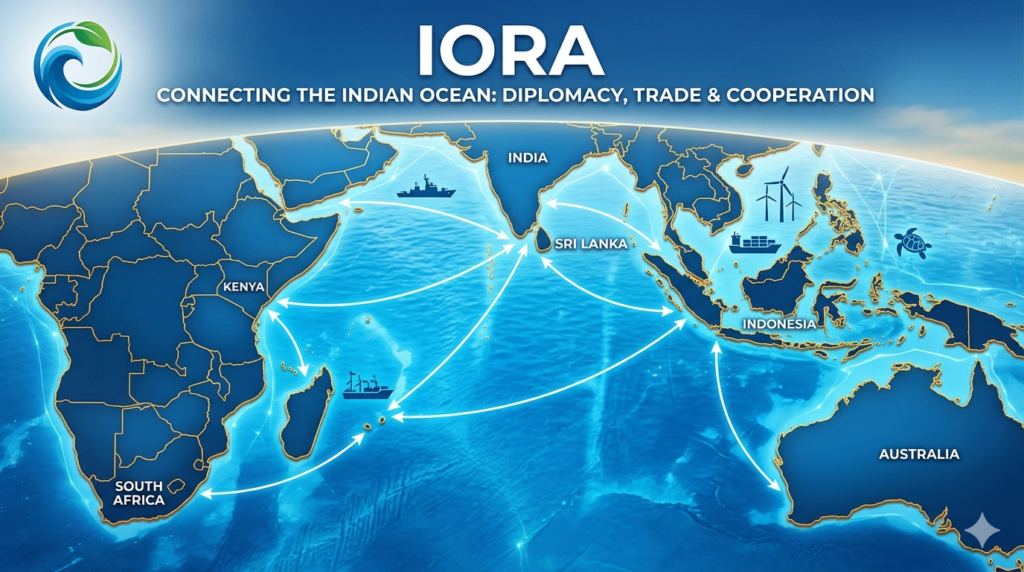
The Indian Ocean is not just water. Rather, it is the world’s third-largest ocean. It is also one of the busiest trade routes on the planet. Furthermore, it connects three big continents — Asia, Africa, and Australia. Consequently, 23 nations came together to manage this Blue Ocean wisely. They formed the Indian Ocean Rim Association, or IORA.
The Blue Ocean Body: Birth and Basics of IORA
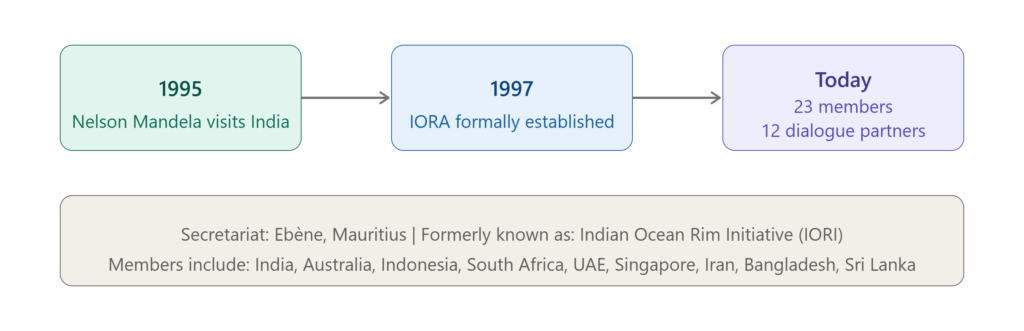
To begin with, the idea of IORA started during Nelson Mandela’s visit to India in 1995. He said: “The natural urge of the facts of history and geography should broaden itself to include the concept of an Indian Ocean Rim for socio-economic co-operation and other peaceful endeavours.” Subsequently, countries formally set up IORA on 6 March 1997.
Eight Pillars Holding Up the Blue Ocean
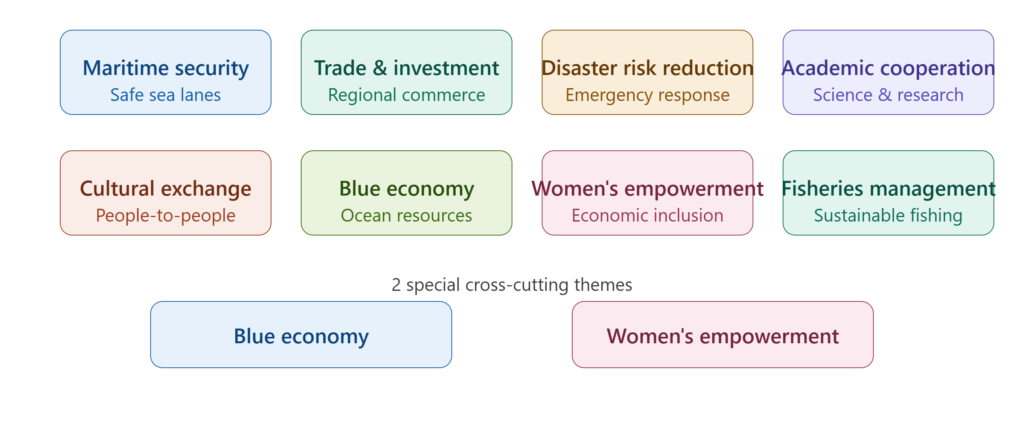
Overall, IORA works across eight priority areas. Additionally, it gives special focus to two themes — Blue Economy and Women’s Economic Empowerment. These two themes run through all its work. Notably, IORA brings together three groups: Government, Business, and Academia.
How Big is This Blue Ocean Region?

Besides this, the Indian Ocean holds some very important sea routes. These include the Strait of Malacca, the Suez Canal, and the Bab-el-Mandeb Strait. These routes connect Asia, Europe, and Africa. Clearly, therefore, whoever controls this Blue Ocean controls global trade too.
India Leads the Blue Ocean: Chairship 2025–2027
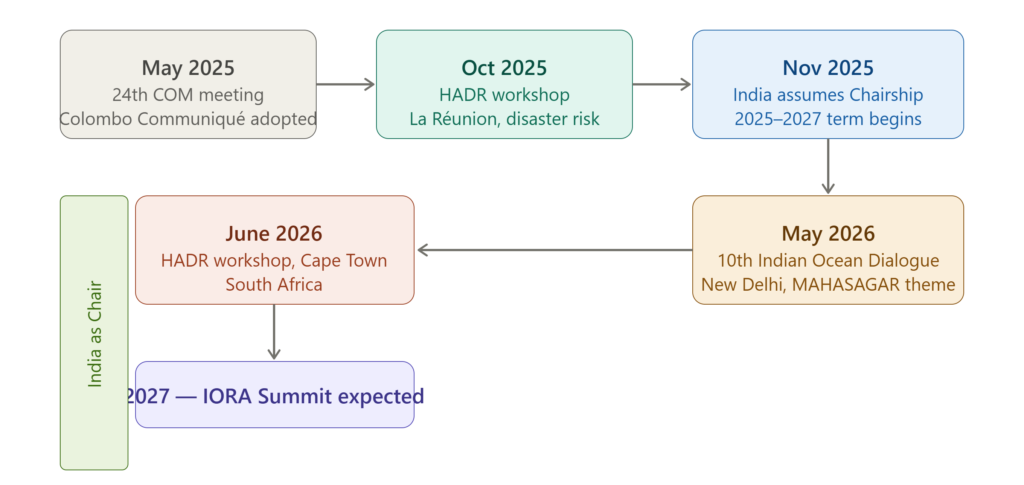
In this regard, India holds the Chairship of IORA under the theme “Innovation, Openness, Resilience & Adaptability in the Indian Ocean Region.” Moreover, Secretary (East) P. Kumaran spoke about India’s strong commitment at the 24th COM meeting. In particular, he said that terrorism, including terrorism backed by states across borders, threatens peace. Therefore, the world must strongly condemn it.
India’s Blue Ocean Vision: From SAGAR to MAHASAGAR
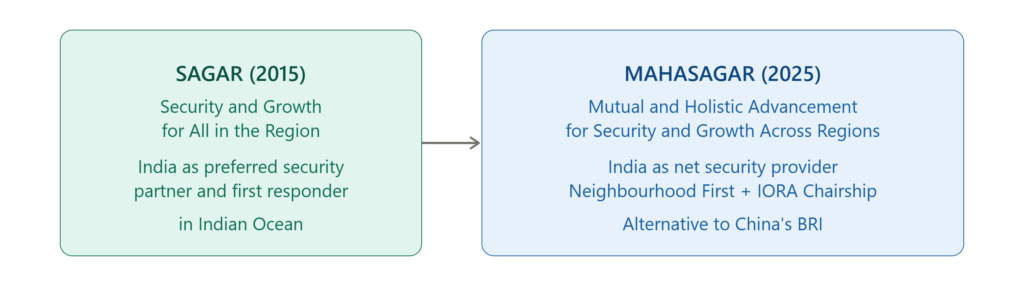
Importantly, China holds only the status of a Dialogue Partner in IORA. It is not a full Member State. As a result, India gets a stronger leadership position in the Indian Ocean. China cannot dominate IORA from within. In contrast to China’s BRI, India’s IORA leadership offers a different path for connectivity — one that does not trap countries in debt.
Blue Ocean Under Threat: The West Asia Factor
Unfortunately, the Blue Ocean faces real dangers today. Specifically, the 10th Indian Ocean Dialogue gained urgency because of the rising conflict in West Asia. Disruptions in the Strait of Hormuz added to this urgency. So did the sinking of the Iranian frigate IRIS Dena near Sri Lanka in March 2026. Consequently, oil prices are rising. Inflation, supply-chain problems, fertiliser shortages, and threats to shipping routes are also hurting Indian Ocean economies.
Quotes for Your Blue Ocean Mains Answers
Nelson Mandela (1995): “The natural urge of the facts of history and geography should broaden itself to include the concept of an Indian Ocean Rim for socio-economic co-operation and other peaceful endeavours.”
India at 10th IOD (2026): “India reiterated its commitment to a peaceful, stable and prosperous Indian Ocean region, guided by its Vision MAHASAGAR and Neighbourhood First policy.”
On IORA’s strategic value: “Unlike China’s BRI, IORA under Indian leadership provides an alternative framework for connectivity that is not transactional or debt-laden.”
📌 Prelims PYQ — Blue Ocean Ready
Q. With reference to ‘Indian Ocean Rim Association for Regional Cooperation (IORARC)’, consider the following statements: (UPSC Prelims 2015)
- It was established very recently in response to incidents of piracy and accidents of oil spills.
- It is an alliance meant for maritime security only.
Which of the statements given above is/are correct?
(a) 1 only (b) 2 only (c) Both 1 and 2 (d) Neither 1 nor 2 ✅
Explanation: IORA was established in 1997 and covers eight priority areas — far beyond just maritime security.
Well articulated and upsc oriented 👏
D (neither a nor B)