
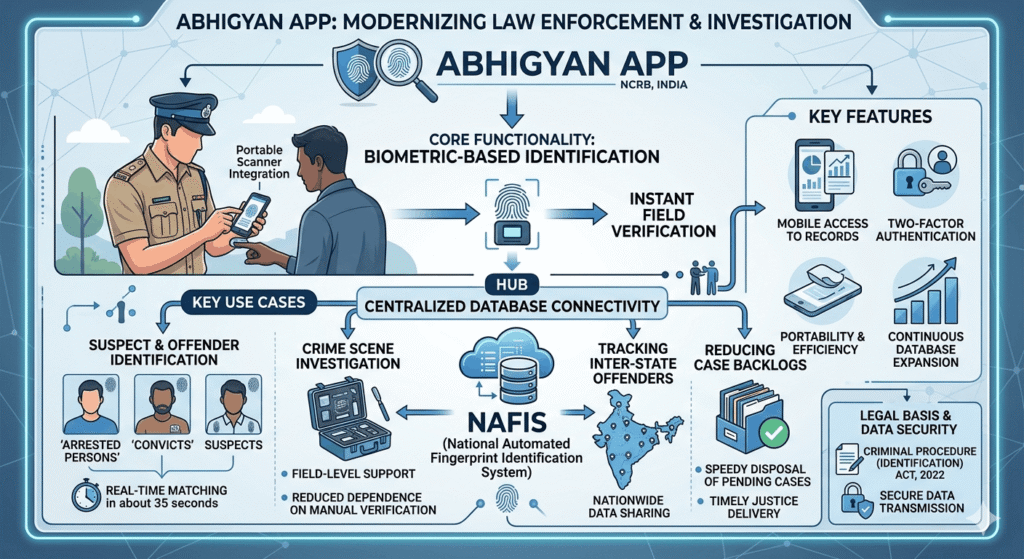
Crime never stays still, and so, the methods to fight it cannot stay still either. Keeping this in mind, the Union Home Minister, Amit Shah, launched the ABHIGYAN mobile application on 19th June 2026. This happened at the 26th All India Fingerprint Conference 2026, held at the Sardar Vallabhbhai Patel Auditorium in New Delhi. Since policing is a state subject, this app is a central tool that supports state police forces rather than replacing them.
What Exactly is ABHIGYAN?
In simple words, ABHIGYAN is a mobile app that lets a police officer scan a person’s fingerprint on the spot and get a match within 35 seconds. Earlier, this same process used to take days. Therefore, the app saves a huge amount of time.
The app has been developed by the National Crime Records Bureau (NCRB), and it works as a portable, mobile version of the National Automated Fingerprint Identification System (NAFIS). So, while NAFIS sits in the background as a big, central database, ABHIGYAN brings that same power into the hands of a constable standing on the street.
How Does It Work?
First, the police officer uses a smartphone-linked scanner to take a person’s thumb impression. Next, this data travels to the NAFIS database, which already holds biometric records of more than 1.29 crore individuals. After that, the system runs the match through automated algorithms. Finally, within seconds, the officer gets the person’s criminal history, if any exists.
Moreover, the database does not stay frozen. Instead, it keeps growing because authorities add new records every time they register a fresh case. As a result, users expect the app’s accuracy to improve further over time.

Why Was Such an App Needed?
Indian policing, for a long time, depended on paper files and manual records. Consequently, by the time an officer fetched old records, a repeat offender often slipped away. In addition, coordination between police of different states remained weak, since each state kept its own separate records.
So, to fix this gap, the government brought several reforms one after another:
- First, CCTNS (Crime and Criminal Tracking Network and Systems) connected police stations digitally.
- Then, NAFIS created one central fingerprint database for the whole country.
- Now, ABHIGYAN takes that same database into the field, right into an officer’s pocket.
Hence, each step builds on the previous one, and together, they form a chain of reforms moving Indian policing from paper to pixels.
Other Apps Launched Alongside ABHIGYAN
Interestingly, the NCRB did not launch ABHIGYAN alone. On the same day, they also launched three more applications:
- CrPI System (Criminal Procedure Identification)
- eProsecution 2.0
- eForensics 2.0
Together, these four tools aim to speed up not just arrests, but the entire chain of justice, from registering a crime to securing a conviction.
Concerns Around the App
That said, every new tool brings its own set of worries, and ABHIGYAN is no exception. Critics point out that there is no clear, written rule yet on when and how officers can stop a “suspicious individual” for a fingerprint scan in the field. Therefore, without proper legal safeguards, there is a risk of overreach, where an officer might check anyone without strong reason. The government, on its part, claims that two-step authentication has been built in to protect against misuse.
Hence, while the app promises speed and efficiency, its real test will depend on training, data quality, and respect for legal boundaries.
Important Quotes for Mains Answers
These lines, spoken by Amit Shah at the launch event, can be used directly while writing mains answers on police reforms, internal security, or governance:
“No criminal, however intelligent, should be able to evade the combined force of law and science.”
“Data yields real value only when transformed into intelligence.”
“Merely apprehending offenders is insufficient… lasting crime prevention can only be achieved when society develops confidence that criminal acts will inevitably result in punishment.”
Linking ABHIGYAN to Broader UPSC Themes
This topic connects nicely to several recurring UPSC themes:
- Police Reforms: ABHIGYAN is part of a long chain of digital reforms following the 2008 Mumbai attacks, since that tragedy first pushed the government toward CCTNS.
- E-Governance: Just like CCTNS, ABHIGYAN follows the larger Digital India vision of using technology for better service delivery.
- Right to Privacy: Since the Supreme Court, in the Justice K.S. Puttaswamy v. Union of India (2017) judgment, declared privacy to be a fundamental right, any large biometric database naturally raises questions about consent and misuse.
- Centre-State Relations: Because police and public order fall under the State List, the Centre can only build and offer tools like NAFIS and ABHIGYAN; states must adopt and run them locally.
Prelims-Specific Practice Question
While a direct prelims question on ABHIGYAN has not appeared yet, since the app is brand new, a similar question has already been asked on its related system, CCTNS. This pattern is likely to repeat for ABHIGYAN in future papers, so practising it builds the right base.
Practice Question (based on real exam pattern):
With reference to the Crime and Criminal Tracking Network and Systems (CCTNS), consider the following statements:
- It is a centralised repository of crime-related data developed exclusively for the Intelligence Bureau and CBI.
- The National Crime Records Bureau (NCRB) is the nodal agency responsible for monitoring the project.
Which of the statements given above is/are correct?
(a) 1 only (b) 2 only (c) Both 1 and 2 (d) Neither 1 nor 2
Answer: (b)
Explanation: Statement 1 is incorrect, since CCTNS serves all police stations and law enforcement agencies across the country, not just the Intelligence Bureau and CBI. Statement 2, however, is correct, as NCRB indeed monitors, coordinates, and implements CCTNS.
Conclusion
To sum up, ABHIGYAN marks one more step in India’s long journey from manual policing toward smart, data-driven policing. On one hand, it promises faster justice and quicker identification of criminals. On the other hand, it also demands strong legal safeguards, so that speed does not come at the cost of individual rights. Going forward, the real success of this app will depend on how well states train their personnel and how carefully the government balances technology with civil liberties.Share